A programme on the future of B2B selling
How B2B salespeople continue to add value for their customers.
That question has driven the Future of Selling research programme since 2009. The conditions of B2B selling have changed significantly since we started — first under pressure from globalisation, e-commerce, and the need for innovation; more recently under pressure from sustainability, geopolitics, regulation, and the repricing of risk. The research programme tracks these changes through interviews, fieldwork, and workshops with B2B firms across Europe and beyond, and publishes what it finds.
Led by Prof. dr. Régis Lemmens (Solvay Brussels School of Economics and Management, Antwerp Management School) and Prof. dr. Javier Marcos (Cranfield School of Management).
The Regenerative Horizon
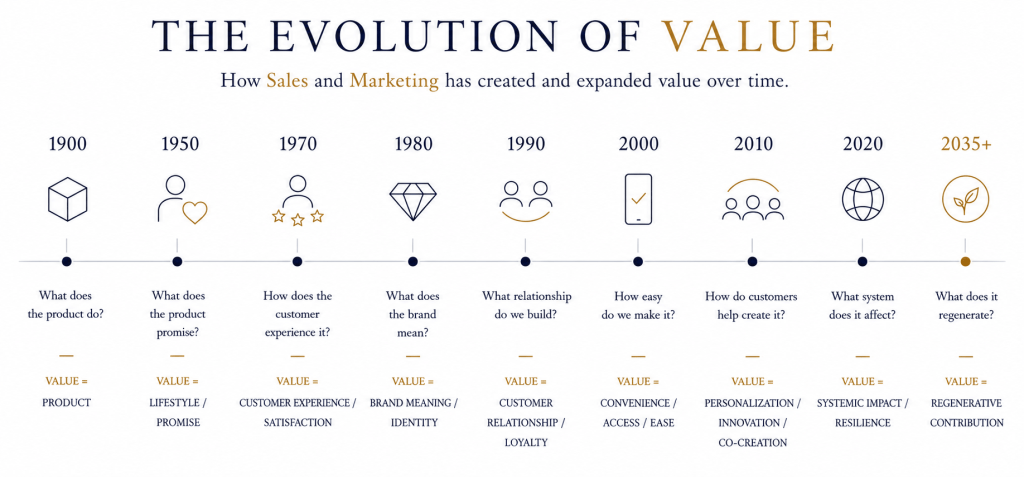
The 2035+ position on the timeline above is a bet, not a forecast. Planetary boundaries research and Kate Raworth’s Doughnut Economics make the direction clear: the next era of value creation will have to go beyond sustainability toward regeneration — putting back more than is taken. The green transition itself sharpens the question. Electrifying our economies is driving nickel mining into Indonesia’s rainforests and putting deep-sea extraction on the table; the solutions to one crisis are creating the next. Tony’s Chocolonely shows that regenerative business models are not only possible but commercially viable. The programme is developing this part of its thinking with Christian Sarkar and Jef Teugels of the Regenerative Marketing Institute — co-founded with Philip Kotler — whose work asks where value is being created, for whom, and at what cost to nature and community. How B2B selling adapts to this is what the Future of Selling programme is investigating in the years ahead.
The arc of the research
From co-creation to value engineering
The same research question, two waves of response. The first integrates into the second.
Past trends · 2009–2018
Selling as co-creation
Driven by globalisation, e-commerce, and the need for innovation. As information asymmetry collapsed, the salesperson could no longer be a talking brochure. The research proposed three forms of co-creation — strategic, experience, and product — documented in the book From Selling to Co-Creating, the 2018 HBR article Entrepreneurial Selling, and a body of cases across multiple industries.
Emerging trends · 2022–present
Value Engineering
Driven by sustainability pressure, geopolitical instability, tightening regulation, and the financial repricing of risk. Co-creation remains foundational but is now nested inside a broader response: a multi-dimensional value framework, the Layered Business Case, and Systemic Value Selling as the operational method. The work is in formation, drawn from interviews and fieldwork across Europe.
Recent field notes
From the programme
Observations from interviews and fieldwork, written as the research produces them.
20 May 2026 · Field note
One Customer, Three Conversations
Two long research conversations with Lien Byttebier at Accent surface a sales model built around three levels of the customer, three propositions, and three languages — and the recognition that selling into large industrial accounts has become an act of coordinated change management. Read →
20 May 2026 · Field note
The Supply Chain Has Become the Sales Conversation
An afternoon with a senior supply chain leader at Kaneka Belgium reveals how industrial supply chains under pressure are reorganising around trust, intelligence, judgement, and integration — and what this means for the suppliers across the table. Read →
Research partners
Solvay Brussels School of Economics and Management · Antwerp Management School · Cranfield School of Management · TIAS Business School
Consulting, workshops, and executive education delivered through Sales Cubes.
 Future Of Selling