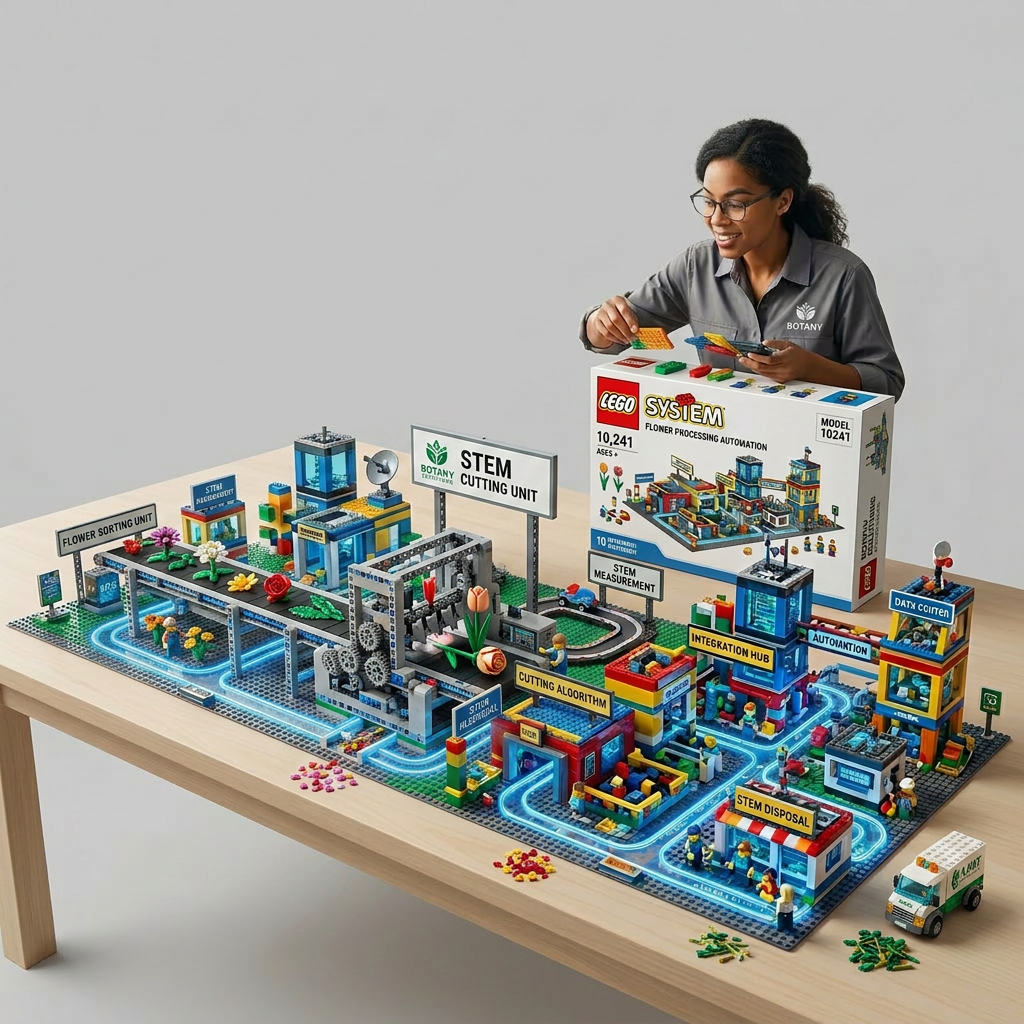
A decade ago, Robovision sold a defined solution against a fixed roadmap. Today it sells a capability for a future neither it nor its customer can yet describe — and that single change has rewritten what its salespeople must be.
Prof. dr. Régis Lemmens — Future of Selling research programme — June 2026
Ten years ago, a high-tech supplier knew what it was selling. There was a specification, a contract, a set of milestones, an eighteen-month roadmap. The customer asked for a defined piece of functionality, and the supplier delivered exactly that. It was a comfortable way to sell, because everyone in the room could see the thing being bought. That world has gone, and the conversation I had with Jonathan, the founder and chairman of Robovision, is one of the clearest accounts I have heard of what replaced it.
Robovision builds an AI platform that lets its customers put artificial intelligence inside their machines — a robotic system that can recognise individual flowers and pick them, for instance, or a vision system on a production line. But the interesting part of the conversation was not the technology. It was what the pace of that technology has done to the act of selling it. Jonathan no longer sells a solution. He sells a capability for a future that neither he nor his customer can yet predict — and he has discovered that this demands a completely different kind of salesperson, one he is still learning how to build.
From the point solution to the LEGO box
I always start these conversations the same way: look back about ten years, to 2015, and tell me what has changed. Jonathan’s answer went straight to the heart of our third trend — the move from selling solutions to enabling systems.
Ten years ago we sold point solutions, fixed contracts, definite milestones, an eighteen-month roadmap. Today the pace is so high that what we sell is a capability — a platform, a LEGO box — and we let the customer shape the AI flows themselves, together with us.
Jonathan, founder and chairman, Robovision
This is a profound shift, and Jonathan was precise about what drives it. The pace of AI is now so high that any player who sells a fixed solution risks becoming irrelevant before the contract is delivered. The customer can no longer specify the functionality they will need, because they do not know what the state of the art will allow in a year. So they no longer ask for a solution. They ask for a toolbox that lets them keep evolving their machine as the technology moves. The supplier who insists on selling a finished, specified product is answering a question the market has stopped asking.
What makes the Robovision case sharper than most is where that flexibility ends up. It does not stop at Jonathan’s direct customer — the machine builder. It is pushed all the way to the end of the value chain, to the customer’s customer, who is given the ability to create the AI themselves.
The beauty of a no-code flow is that the end customer does not program it. An operator at the line — someone used to start, stop and reset — looks at images, clicks, and creates an AI system. Not an IT expert.
Jonathan, founder and chairman, Robovision
This is the systems logic taken to its conclusion. Robovision does not sell a capability it keeps for itself; it sells a capability that distributes capability further downstream. The line operator who could previously only run the machine can now reconfigure its intelligence. AI, in this telling, is not the product. It is the thing that lets people at the edge of the value chain do something they simply could not do before — and that is what the customer is actually paying for.
From supplier to partner
When the thing you sell is an evolving capability rather than a finished product, the relationship that carries it has to change too. Jonathan described a shift from being a supplier to being something much closer to a member of the customer’s own innovation team.
We have become more important in the change of the company — in defining the USPs, in the innovation roadmap. We have become a co-creation team building the future of that company together. Ten years ago, things were fixed, delivered, and often not up to speed with what the end customer really wanted.
Jonathan, founder and chairman, Robovision
He drew a contrast here that is worth holding onto. In many sales niches, he observed, the pressure runs the other way — towards commoditisation, towards selling at scale, towards stripping the relationship down to price and volume. In his niche, the opposite has happened: partnership has become more important, because the value the two firms create together is what lets the customer survive in a far more competitive world than the one they faced a decade ago. The co-creation is not a softer, friendlier way of selling. It is the mechanism by which the customer stays alive, and that is why they now look at Robovision as a partner rather than a vendor.
The salesperson who has to be a visionary
Here the conversation arrived at the problem that clearly occupies Jonathan most. If you no longer sell a defined solution, then the person doing the selling can no longer be a conventional salesperson. They have to be able to imagine, with the customer, a future that does not exist yet.
It is a very difficult ball game. You expect them not only to be an expert in the customer’s ecosystem — you expect them to be a kind of futurist consultant, defining innovation and roadmap changes inside that specific ecosystem. It is not easy.
Jonathan, founder and chairman, Robovision
This is our fourth trend made concrete. As information stops being the seller’s advantage — as customers can learn the technology online and AI handles the routine work — the value of the human salesperson moves to exactly the things a machine and a brochure cannot do: abstract and intellectual thinking, the ability to read a customer’s ecosystem and to build a roadmap into a future no one can specify. Jonathan needs salespeople who are visionaries, who know the sector and its language but can also think ahead and design the path forward with the client. That is a rare and demanding profile, and finding it is, in his word, very challenging.
Where do you find a visionary customer?
The same difficulty appears on the demand side, and Jonathan was candid about it. A co-creation sale does not only need a visionary seller; it needs a visionary buyer, someone willing to build the future rather than purchase a specification. And those people are remarkably hard to identify.
Cold mailing and cold calling obviously do not work. You cannot tell a visionary from a LinkedIn profile or a job title. So I have to be out there — on stages, on other continents, giving business classes — to find the ponds where these visionary people gather. Then I catch two flies in one hit.
Jonathan, founder and chairman, Robovision
There is a quiet lesson here for any supplier moving from transactional to co-creative selling. The traditional demand-generation machine — lists, cold outreach, titles, scale — is built to find buyers for a known product. It is useless for finding the rarer thing: a customer open enough to change, to co-create, to commit to a roadmap rather than a deliverable. You cannot filter for that on a database. You have to go where such people congregate and meet them in person. The shift from solution to capability does not just change the salesperson; it changes the entire method of finding the people worth selling to.
The founder who has to clone himself
Every honest research conversation has a place where the practitioner’s reality is messier than the framework would like, and with Jonathan it was impossible to miss, because he raised it himself and kept returning to it. The visionary, co-creating salesperson the model demands is, in essence, a replica of the founder. And a founder is the one thing you cannot easily replicate.
As a founder you want to build a company that is not dependent on you in the sales process. So I have to push my own people — push my VP onto the stage so they can shine — and let the organisation grow without me being the spider in the web.
Jonathan, founder and chairman, Robovision
This is the genuine tension, and I do not want to resolve it too neatly, because Jonathan has not resolved it either. The founder has the vision; selling from vision is effortless for the person who holds it. The whole challenge of scaling is to clone that capability into people who did not invent it — to manufacture, in others, the visionary judgment that came naturally to one. The framework can tell you that the future salesperson must be a visionary co-creator. It cannot tell you how to mass-produce one, and the firms living this transition, Robovision included, are still working it out in real time.
There is one structural choice that makes the problem survivable, and it is worth naming because other suppliers can copy it. Robovision deliberately limits itself to a small number of niches — healthcare, manufacturing, agriculture — precisely so that the roadmap stretch is possible. You cannot be a futurist consultant in ten ecosystems at once. By narrowing the field, Jonathan makes it realistic for a team to become genuinely expert in a customer’s world, and to act as the ambassador of that customer’s roadmap inside Robovision itself. This points to the second half of the job that is easy to overlook: the visionary salesperson has to win not only the customer outside, but the organisation inside. A new roadmap item from a major customer has to be carried, internally, by the team that owns that niche — sold twice, once to the client and once to one’s own colleagues who must build it.
What Robovision teaches the rest of us
Robovision sits at the leading edge of the technology trend, and that makes it an unusually clear lens on where much of B2B selling is heading. The specifics are about AI platforms and no-code flows, but the pattern generalises. When the pace of change outruns the customer’s ability to specify what they need, the product becomes a capability rather than a solution; the relationship becomes a partnership rather than a transaction; the salesperson becomes a co-creator of the customer’s future rather than a presenter of features; and the supplier’s hardest problem stops being the product and becomes the people — finding them, growing them, and freeing the founder from being the only one who can do the job.
Jonathan put the destination more plainly than any framework could. He is trying to build a company that can imagine the future with its customers without needing him in the room. That is the real work of the transition — and the supplier who manages it owns something no competitor selling finished solutions can touch: a place inside the customer’s future, before that future has even been decided.
This article is part of the Future of Selling research programme, co-led by Prof. dr. Régis Lemmens (Solvay Brussels School / AMS Antwerp Management School) and Prof. dr. Javier Marcos (Cranfield School of Management), continuing the work published as From Selling to Co-Creating (Lemmens and Marcos, 2014). It draws on a Future of Sales podcast conversation with Jonathan, founder and chairman of Robovision. Quotes are lightly edited for clarity. To follow the research, visit futureofselling.eu.
 Future Of Selling
Leave a comment